When we think about tracking down fascinating wildlife, it is easy to assume we have to venture miles away from home. Yet, some of the most specialized and ecologically diverse species are thriving right on our doorsteps. If you step outside after a tropical downpour and inspect the damp vegetation around a village backyard, an entire world of miniature amphibians comes alive.
On a recent post-rain inspection of the garden foliage, I spotted this incredible miniature amphibian resting on a slick, wide leaf, captured here. This tiny specimen is a type of microhylid, closely resembling a Bornean Chorus Frog (Microhyla species). The stark visual contrast is fantastic: a reddish-brown, granulated skin texture with dark lateral bands along its side, making it blend seamlessly with wet autumn leaves but giving it a sharp, prominent profile against the glossy green leaf backdrop.
The Precision of Close-Up Work on Slick Foliage
Photographing small amphibians in a backyard garden setting brings an entirely different set of environmental challenges compared to tracking quick-jumping insects. Frogs might remain completely stationary for a few moments, but their wet skin and the slick surface of rain-washed leaves mean you are fighting complex reflections.
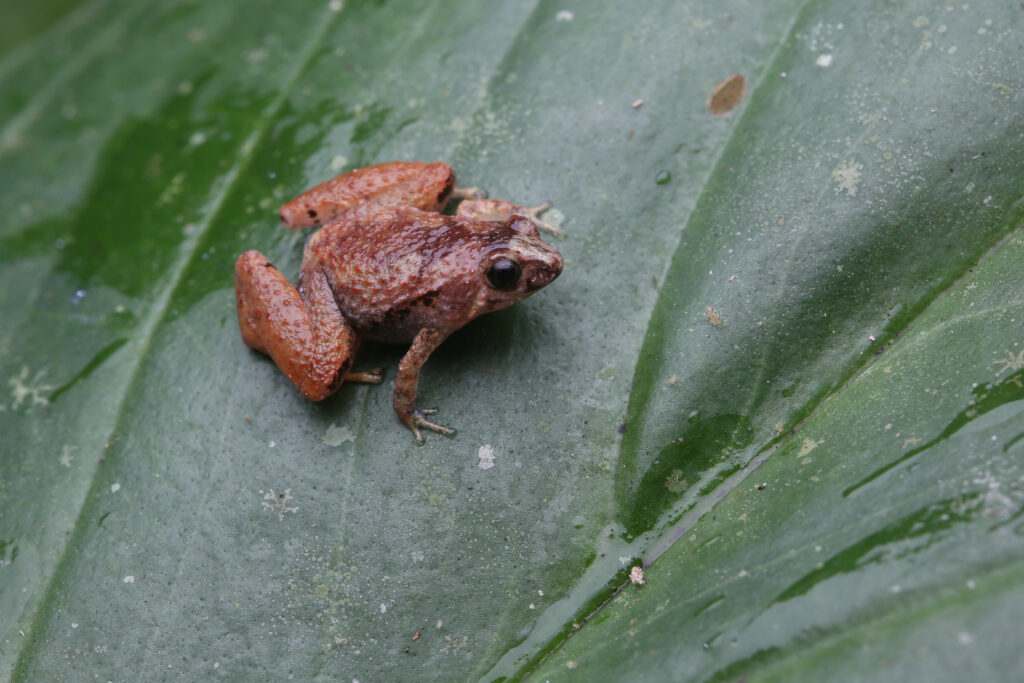
At close-up magnification ranges, maintaining a stable position is everything. Even a slight tilt of the lens can cause the frog’s large, dark compound eyes or the fine texture of its front digits to fall completely out of the razor-thin depth of field. To lock in the stunning skin gradients and granular details visible in here, I had to brace my stance down at foliage level, waiting for the perfect pause between its breathing movements to secure a sharp, tack-focused exposure.
Soft Diffusion for Glistening Amphibian Textures
The biggest technical hurdle when photographing a damp frog is managing the “hot spots” created by artificial lighting. Because its skin is naturally moist, using raw, direct flash would create harsh, blown-out white reflections off its back and head, completely ruining the natural color depth and masking the fine textures of the skin.
To counter this, I rely heavily on a custom-built flash diffuser. The diffuser effectively scatters the flash, allowing soft, wrap-around light to illuminate the frog’s body evenly. This controlled light brings out the beautiful, rich reddish-brown tones and subtle dorsal patterns without washing out the glistening surface of the wet leaf, letting the dark background drop away naturally to highlight this incredible backyard resident.