When you commit to exploring a village backyard with a macro mindset, the world changes. You quickly realize that some of the most striking biodiversity in Sarawak doesn’t require a massive trek out into remote terrain. It’s right there, clinging to the stems of everyday garden plants, navigating environments carved out of raindrops and morning dew.
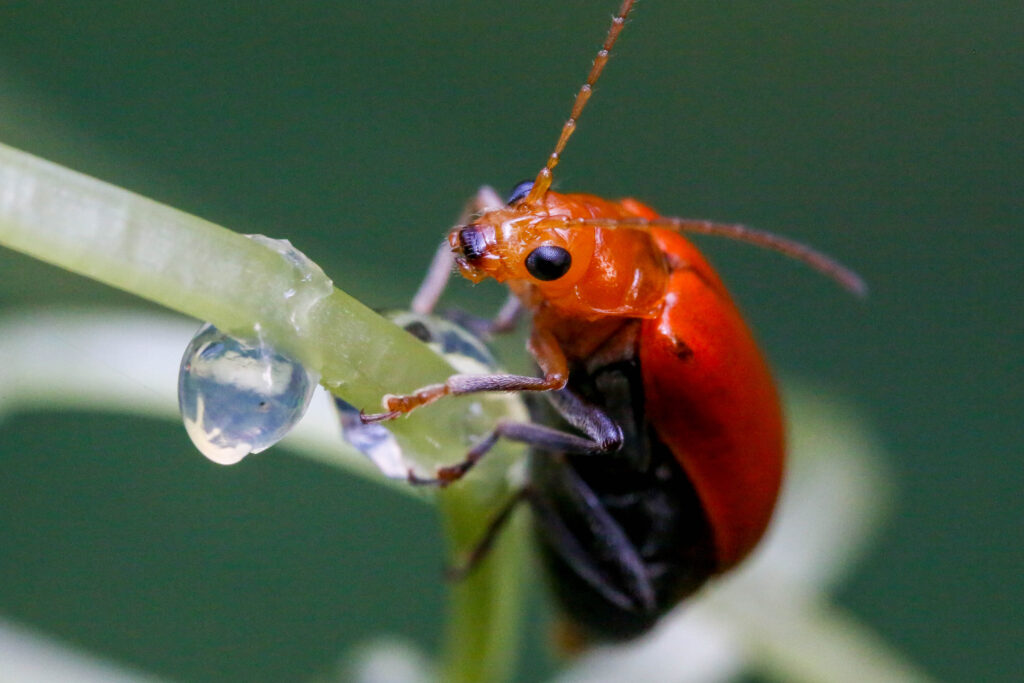
On a recent walk through the yard, I spotted a vibrant flash of orange suspended on a thin green stem, captured here. This gorgeous specimen is a Pumpkin Leaf Beetle (Subfamily Galerucinae), a member of the diverse leaf beetle family (Chrysomelidae). The composition here is all about rich, contrasting elements: the insect’s bright orange pronotum and elytra matching perfectly against a glossy black underbody, positioned right next to a pristine, clear droplet of water hanging off the plant stem.
Navigating the Challenges of High-Magnification Curves
Photographing small, hard-shelled beetles introduces a distinct technical puzzle. Because leaf beetles spend their lives feeding on plant tissues, they are constantly active—climbing up stems, shifting under leaves, and testing the air with their antennae.
To lock in the incredibly crisp profile, stability is everything. At close range, your depth of field shrinks to a fraction of a millimeter. If your camera plane shifts even slightly, you lose the tack-sharp focus on the beetle’s dark compound eye or the texture of its segmented legs. I had to brace carefully against the ambient movement of the garden foliage, waiting for that exact split second when the beetle paused its climb to press the shutter. The result captures a true-to-life documentary slice of backyard life, sharply resolving the fine claws gripping the stem alongside the suspended water droplet.
Soft Diffusion for Highly Reflective Exoskeletons
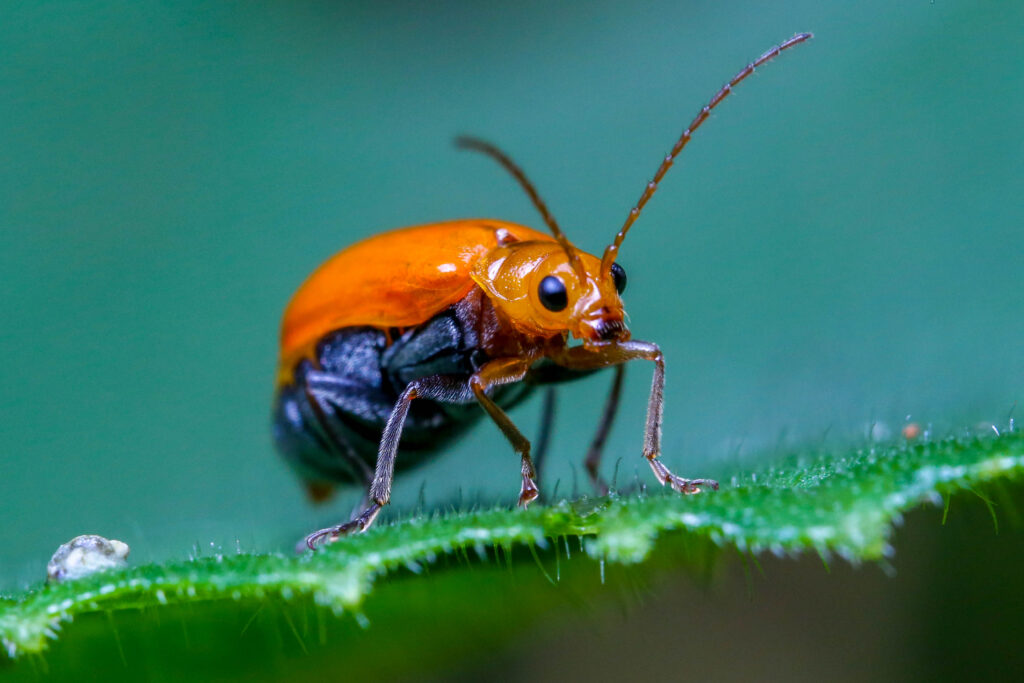
The smooth, polished exoskeleton of a leaf beetle is essentially a curved mirror. If you hit a subject like this with raw, direct flash, you will end up with ugly, blown-out white glare spots that completely erase the rich orange color and structural details of the shell. The water droplet next to it acts exactly the same way, threatening to become a blinding point of light.
To keep the exposure smooth and true to life, I use a custom-built diffuser on my flash setup. The diffused light wraps gently around the beetle’s rounded carapace and passes cleanly through the water droplet. This eliminates harsh specular highlights, allowing the subtle textures of the beetle’s head, the fine segments of its antennae, and the transparency of the water to show through naturally while the background transitions into a soft, dark green bokeh.