When exploring the rich ecosystems of Sarawak, it is easy to think that incredible wildlife can only be found deep inside national parks. However, adjusting your perspective downward reveals an extraordinary array of micro-fauna thriving right in our own backyards. Taking the time to slow down allows these tiny engineered marvels to emerge right outside our doorsteps.
On a recent afternoon checking the foliage around my village backyard, I documented a striking hemipteran resting dead-center on a vibrant green leaf, captured here. This small insect is a Leafhopper (Family Cicadellidae), distinguished by its pale, chalky-white body, light blue wing gradients, and precise dark facial spots. The stark contrast between the insect’s smooth, icy palette and the deep, textured green veins of the host plant makes it a compelling subject for high-magnification close-ups.
The Chaos of the Backyard: Working with Highly Active Subjects
Photographing small, highly sensitive insects like leafhoppers presents a constant test of patience—and a heavy dose of reality. These creatures possess specialized hind legs designed for explosive jumping at the slightest hint of danger. Approaching them requires slow, deliberate movements, but even the stealthiest approach doesn’t guarantee a cooperative subject.
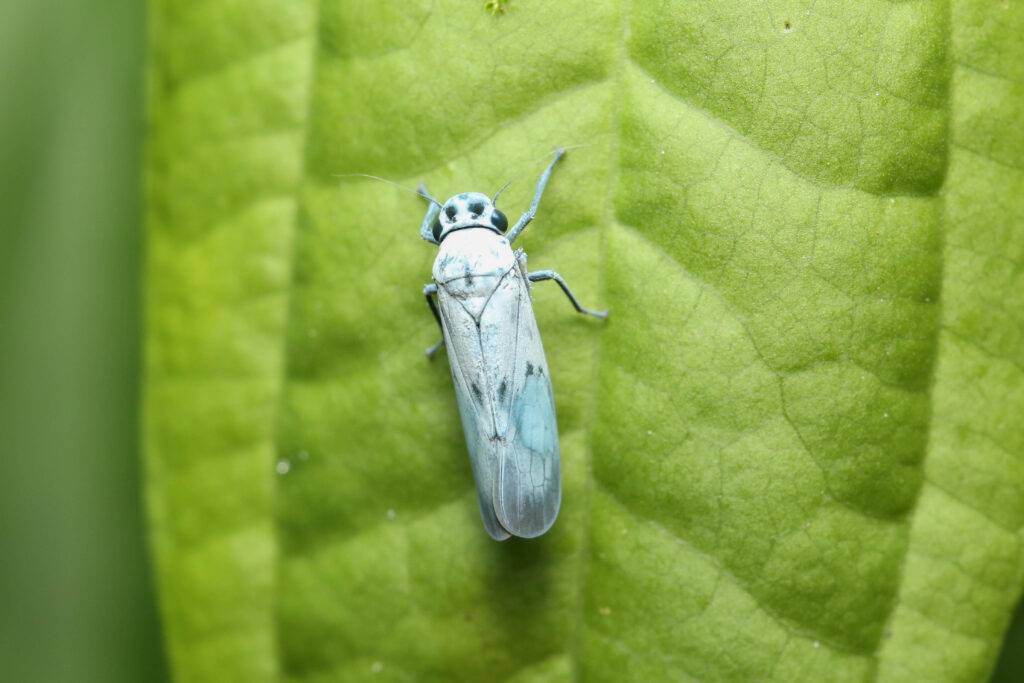
In the field, things rarely go completely by the book. While the goal is often to dial the lens all the way to a native 1:1 magnification ratio, this particular specimen was incredibly jumpy. Between its erratic skittering and the constant threat of it flying off entirely, there simply wasn’t time to lock down a textbook 1:1 setup. Instead, it became a fast-paced game of tracking a moving target right there in the garden. I had to react instantly, relying on quick reflexes and a bit of pure luck to secure a sharp, well-composed frame before it vanished into the brush. In the end, capturing a clean documentary shot of this specimen for the collection was a victory won by timing rather than rigid technical staging.
Soft Diffusion for Low-Reflective Textures
The chalky, pale coloration of this leafhopper presents a unique exposure challenge in the field. Under the natural shadow of yard foliage, light levels fluctuate constantly. Relying on an un-diffused, direct hot-shoe flash would easily overexpose the bright white carapace, blowing out the delicate dark spots on its head and the soft blue tones along its wings.
To maintain true-to-life color depth and crisp textures, I pair the flash setup with a custom-built diffuser. The soft, diffused light spreads evenly across the leaf’s matte surface and wraps around the insect’s body. This controlled illumination prevents harsh highlights, rendering the subtle details perfectly while allowing the surrounding foliage to frame the subject naturally.