Night in the rainforest changes everything. The loud, chaotic visual landscape of the day strips away, leaving you with a wall of sound and a narrow beam of flashlight. For a macro photographer, this is when the true magic happens. When the background disappears into pitch black, the smallest creatures take center stage.
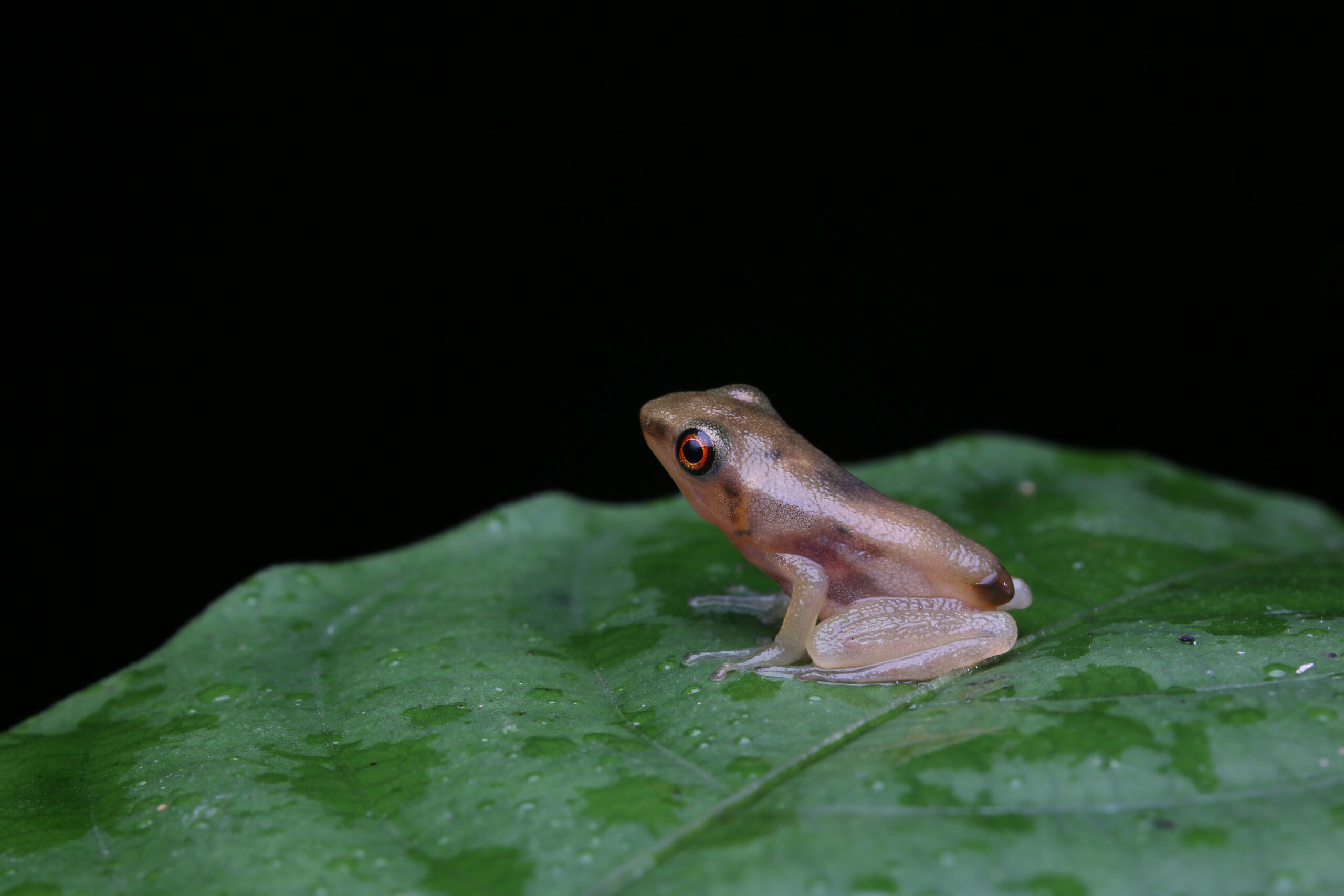
During a recent evening trek, catching a tiny glint of amber reflection on a wet leaf led me straight to this stunning little frog.
The Translucent Wonder
Look closely at its flanks and hind legs—the skin is so delicate and thin that it’s nearly translucent, letting you faintly see the underlying muscle structure. But the absolute showstopper is the eye. That brilliant, fiery orange iris ringed with deep charcoal creates an intense, captivating contrast against its muted, pale body.
In the field, these tiny frogs are masters of laying low. They don’t rely on massive size or toxic bright colors; instead, they blend into the glistening, rain-slicked foliage, remaining completely motionless until an insect wanders too close.
Behind the Shot: Mastering the Low-Angle Profile
Photographing tiny amphibians at night comes with a unique set of technical hurdles. It’s easy to get a “snapshot” of a frog from above, but to get an image that truly tells a story, you have to change your perspective.
- Getting Down on Their Level: To get this profile shot, I had to drop the camera right down to the leaf level. Shooting from a low angle parallel to the frog does two critical things: it creates an intimate portrait that respects the subject’s perspective, and it isolates the frog beautifully against the background.
- The Pitch-Black Canvas: A lot of people ask how to get that clean, velvety black background. It’s not done in Photoshop—it’s pure physics. By using a fast shutter speed, a low ISO, and a narrow aperture (around f/11 to f/16), you ensure the camera only records the light from your flash. Because there is nothing immediately behind the leaf for the flash to hit, the background falls away into a gorgeous, natural void.
- Managing Specular Highlights on Wet Skin: Amphibians need to keep their skin moist to breathe, which means they are constantly covered in a thin layer of fluid. To a macro flash, that wet skin acts like a hundred tiny mirrors. If your flash diffusion isn’t perfect, the frog’s back will be covered in distracting, blown-out white spots. Using a large, soft custom diffuser spreads the flash out, changing harsh reflections into gentle, soft highlights that emphasize the moist texture of the skin and the droplets on the leaf without clipping the details.
There is something deeply rewarding about isolating a single, fragile life out of the vast, dark rainforest canopy. It’s a tiny glimpse into a nightlife that usually goes completely unseen.
What’s your go-to technique for eliminating harsh specular highlights when shooting wet or glossy subjects in the field? Let’s swap diffuser designs in the comments below!