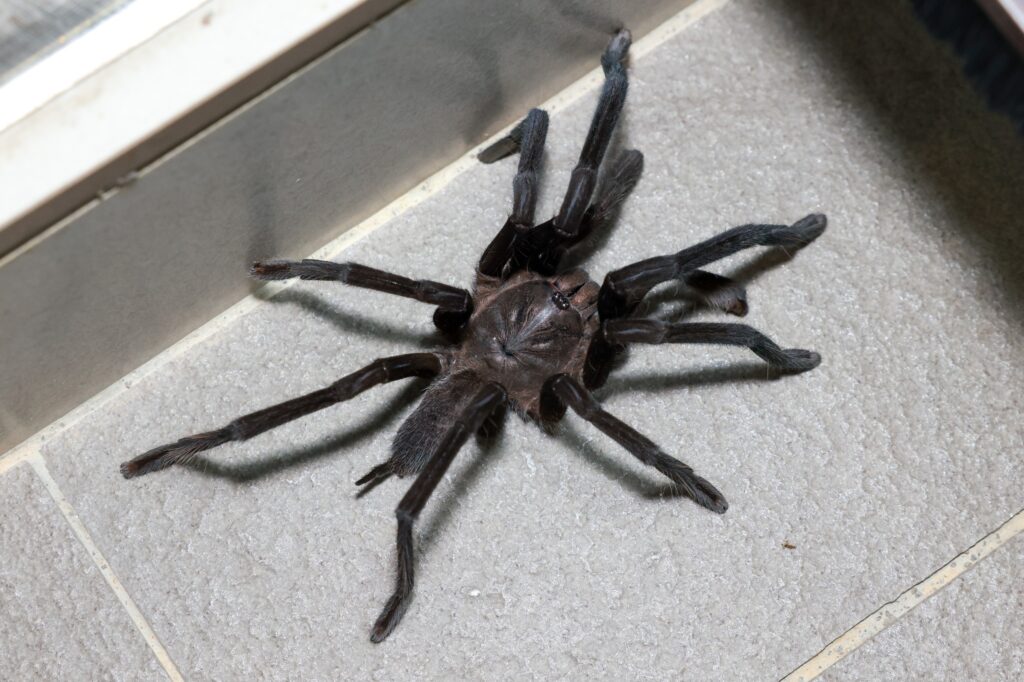
Finding wildlife in Sarawak isn’t unusual, but sometimes the micro-wilderness comes right to your doorstep—or in this case, right into the office corridors of Kuching. During a routine day, I crossed paths with a massive, velvety dark spider tucked into a tiled corner.
For an arachnid enthusiast, an encounter like this is pure gold. Let’s dive into the details of this striking specimen, its behavior, and how to photograph these leggy giants when you have to work with the gear on hand.
Identifying the Specimen: Borneo’s Velvet Giants
From its dark, iridescent coloration and long, gangly legs, this impressive arachnid is a tarantula belonging to the subfamily Ornithoctoninae, commonly known as Earth Tigers. Based on its visible features, it strongly resembles a mature male from a genus like Phormingochilus or Lampropelma, both of which are native to the dense rainforests of Borneo.
⚠️ Important Disclaimer: While general visual characteristics point heavily toward these local Earth Tiger genera, precise species identification for tarantulas requires close anatomical examination. Confirmation from an expert arachnologist is highly needed to definitively identify this specimen, as many overlapping species share nearly identical coloration and leg spans in the field.
Wait, Does it Have a Tail?
If you look closely at the top-down perspective in the image below, you might notice two prominent, finger-like structures protruding from the rear of the abdomen that almost resemble a split tail. These are actually spinnerets! In many old-world tarantulas, these structures are remarkably long and highly mobile. They act like precision tools, allowing the spider to weave intricate silken mats, line burrows, or spin alarm systems to detect incoming prey.
Technical Notes: Working with the Gear on Hand
Photographing a large, dark tarantula against a light-colored tiled floor presents a unique set of challenges, especially when you don’t have a dedicated macro lens mounted.
- The On-the-Fly Setup: For both images above, I paired an RF 24-70mm f/2.8 lens with an external flash equipped with a simple cap diffuser. While a standard zoom won’t give you the extreme 1:1 magnification of a dedicated macro lens, it’s an incredibly versatile setup for safely framing a fast-moving, massive arachnid before it scurries away.
- Managing Harsh Lighting and Reflections: Because a basic cap diffuser doesn’t soften light as drastically as a large, custom field diffuser, the highly reflective office tiles threw some harsh highlights back into the frame. When dealing with the dark, velvety exoskeleton of an Earth Tiger, these strong highlights are tricky, but they do an excellent job of highlighting the coarse textures and fine sensory hairs (setae) on the legs.
- Maximizing the Crop: Shooting at a wider focal length means relying on a high-resolution sensor to crop into the frame afterward. The key here is securing sharp focus right on the ocular turret (the cluster of eyes) or the chelicerae (fangs) so that the details hold up when you blow the image up.
Respecting Sarawak’s Urban Wildlife
While their imposing size and quick bursts of speed can be startling, these tarantulas are a vital part of Borneo’s rich ecosystem, keeping insect populations in check. They generally prefer flight over fight, opting to retreat or display a classic threat posture rather than strike.
Finding one in the concrete jungle is a humbling reminder that no matter how urbanized our surroundings get, the ancient wilds of Sarawak are always just a heartbeat away.
Have you ever encountered a tarantula wandering outside of the jungle? Let me know in the comments below!