If you spend enough time looking into the dark spaces of the tropical understory, eventually, something spectacular looks back.
On my final trek of the day, my headlamp caught a massive, robust shadow clinging to a vertical trunk. At first glance, its sheer bulk, thick legs, and velvety texture make it easy to mistake for a tarantula. But a quick look at the positioning of its legs reveals its true identity: an absolute titan of a huntsman spider, a member of the heavy huntsman genus Thelcticopis.
And when you look at it head-on, it becomes immediately clear why this is one of the most striking predators in the forest.
The Fiery Face of an Apex Hunter
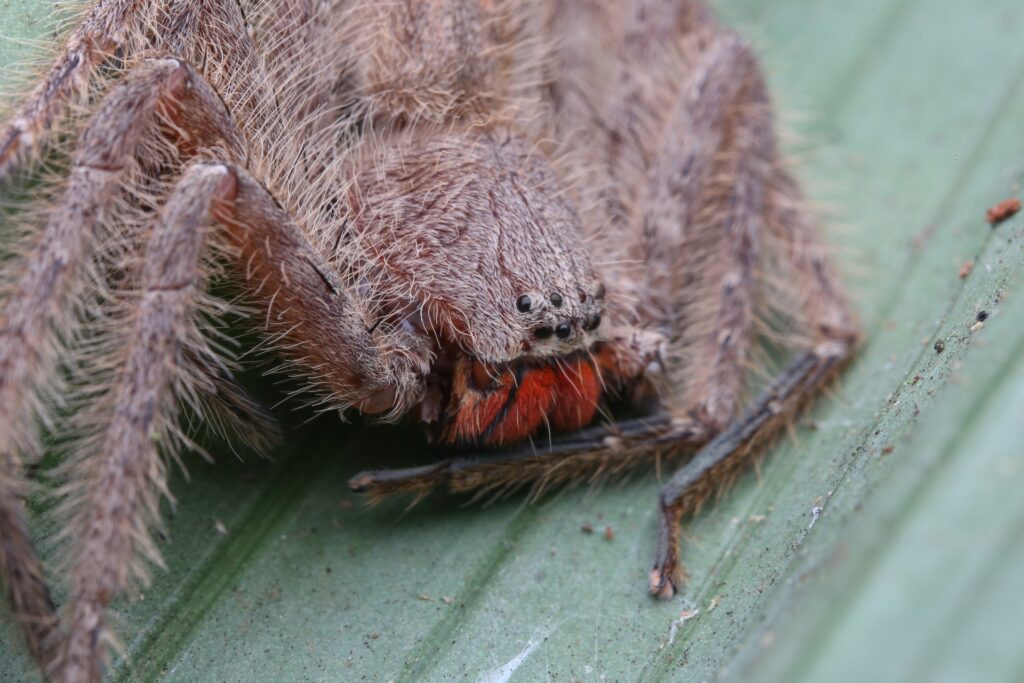
While many huntsman spiders rely on flattened bodies and dull brown shades to slide into tight crevices under bark, this heavy-bodied species takes a completely different visual approach.
Its robust body is draped in dark, velvety golds and deep charcoals, but its face features an intense, highly localized explosion of bright, warning orange-red hairs. This fiery “beard” rings its powerful jaws (chelicerae) and surrounds its eye cluster, creating an incredible, aggressive contrast.
Unlike orb-weavers that wait for food to stumble into a net, this is an active, cursorial hunter. It stalks the leaf litter and tree trunks at night relying on pure speed, explosive strength, and high-impact physical power to overpower its prey.
Behind the Shot: Standing Your Ground at 1:1 Magnification
Photographing an arachnid of this scale and speed brings a massive adrenaline rush, alongside a very specific set of technical challenges.
- The Standoff Ratio: Moving in for a tight, front-on facial portrait (
SJE_0074.jpg) means putting your front lens element just inches away from a lightning-fast spider that is entirely capable of sprinting or jumping if provoked. Keeping a steady hand and tracking focus when your viewfinder is filled with giant, fiery jaws requires a lot of patience. - Managing Deep Shadows and Velvety Textures: The dark, dense hairs covering the spider’s body absorb a massive amount of light. If your flash is too weak, you lose all the structure of the legs and abdomen to flat black shadows. If it’s too strong, you blow out the bright red facial hairs. Achieving this perfect balance requires precisely dialing down your flash power and utilizing a custom diffusion system to push soft light into the dense fur, revealing the individual texture of every sensory hair.
- Eye-to-Eye Sharpness: With an eight-eyed hunter like this, your focal point must be flawless. The depth of field at close range is so thin that if you lock focus on the front of the jaws, the eyes will go blurry. By aligning the camera sensor parallel to the spider’s face and stopping down the aperture to a sweet spot of f/11, you can keep both the needle-sharp tips of the pedipalps and the glossy array of eyes perfectly crisp in a single frame.
Watching this fiery predator melt back into the dark shadows of the tree roots was the perfect way to wrap up a day in the field. Borneo never fails to deliver.
How do you handle the adrenaline when working inches away from massive, lightning-fast subjects in the field? Let’s talk tracking tips in the comments below!