There is an entire ecosystem hanging suspended in the shadows of the Sarawak undergrowth. When you dial down your lens and move past the larger forest inhabitants, you begin to see the architecture of the jungle floor—built entirely out of silk threads and anchored by highly specialized predators.
On a recent night trek, I focused my gear on a striking arachnid hanging suspended beneath a leaf, documented here. This specimen is a Long-Jawed Orb-Weaver (Genus Tetragnatha), often referred to as the Silver Stretch Spider due to its metallic coloring and unique resting posture. The visual contrast in this composition is remarkable: a brilliant silver and dark-banded abdomen, coupled with a translucent, soft green cephalothorax and an orange-tinted facial region.
Mastering High-Magnification Macro on Delicate Substrates
Photographing Tetragnatha species in their natural environment presents an intricate technical puzzle. These long-jawed spiders construct delicate orb webs that are typically inclined horizontally over damp foliage or slow-moving streams. Because they rely heavily on high humidity to avoid dehydration, you will almost always find them clinging to soft leaves or thin grass blades.
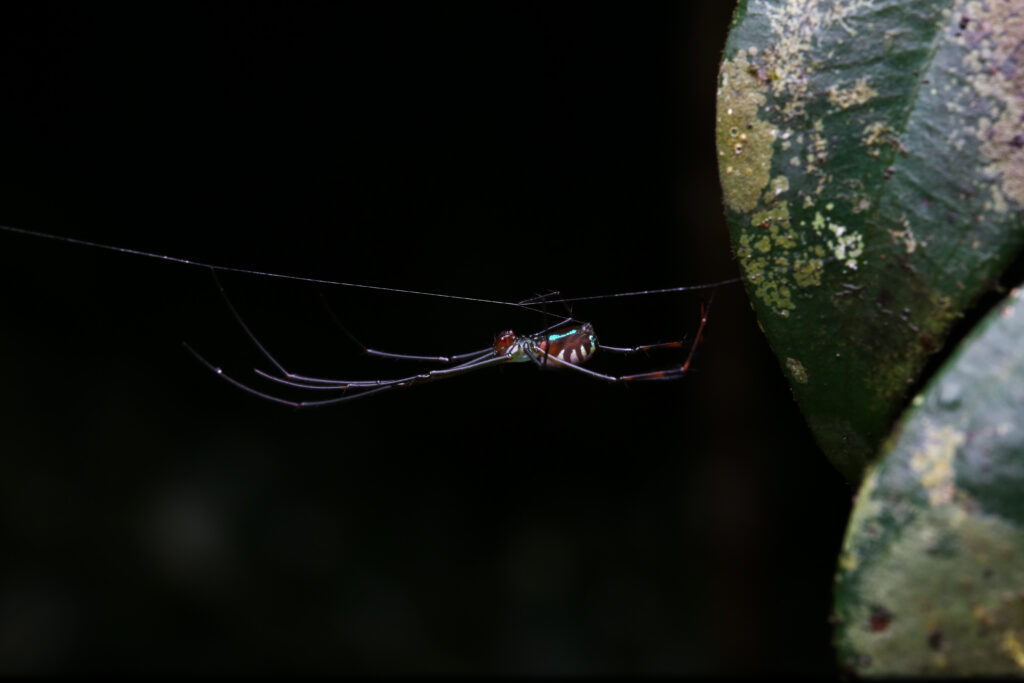
The immediate challenge for a macro photographer is stability. Even the gentlest forest breeze will cause a thin leaf to sway out of your focus plane. Because macro depth of field at close range is razor-thin, managing a multi-frame focus stack requires absolute patience. To capture the crisp textures of the leaf’s surface alongside the spider’s slender, dark legs, I utilize a rigid tripod or monopod setup paired with micro-shifting techniques. This ensures every critical structural element—from the fine hairs on the legs to the compound geometric patterns on the abdomen—is rendered tack-sharp.
Controlling Light on Metallic and Translucent Textures
One of the easiest ways to ruin a high-magnification macro shot of a shiny subject is using direct, un-diffused artificial light. The reflective silver abdomen of a Tetragnatha spider acts like a tiny mirror, creating harsh, blown-out highlights that erase the intricate pattern details underneath.
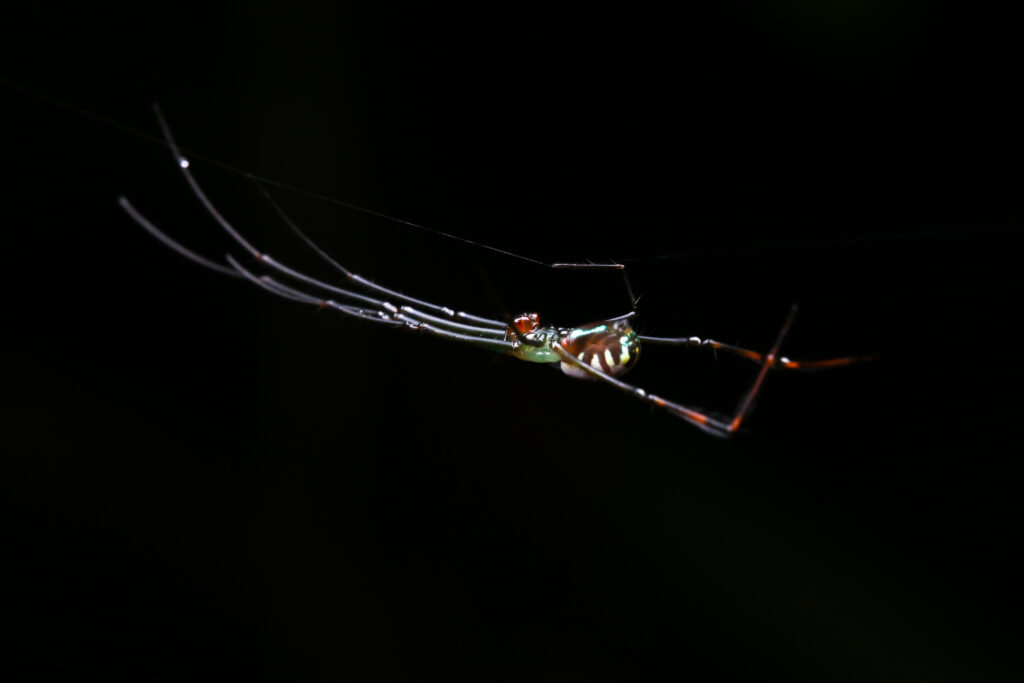
To solve this, I rely heavily on a custom-built flash diffuser wrapped tightly around my macro strobe setup. By diffusing the light, the flash doesn’t bounce harshly off the spider’s shell; instead, it softens the illumination, wrapping gently around the translucent green cephalothorax and showcasing the internal color depth without overwhelming the frame. This soft, directional flash allows the background to fall into a natural, deep black bokeh, throwing the entire focus of the viewer onto the vivid anatomy of the spider.
Documenting these incredible creatures at a 1:1 magnification level serves as a constant reminder of the complexity hidden in plain sight. Every leaf and stream bed in Borneo holds an engineering marvel waiting to be framed.