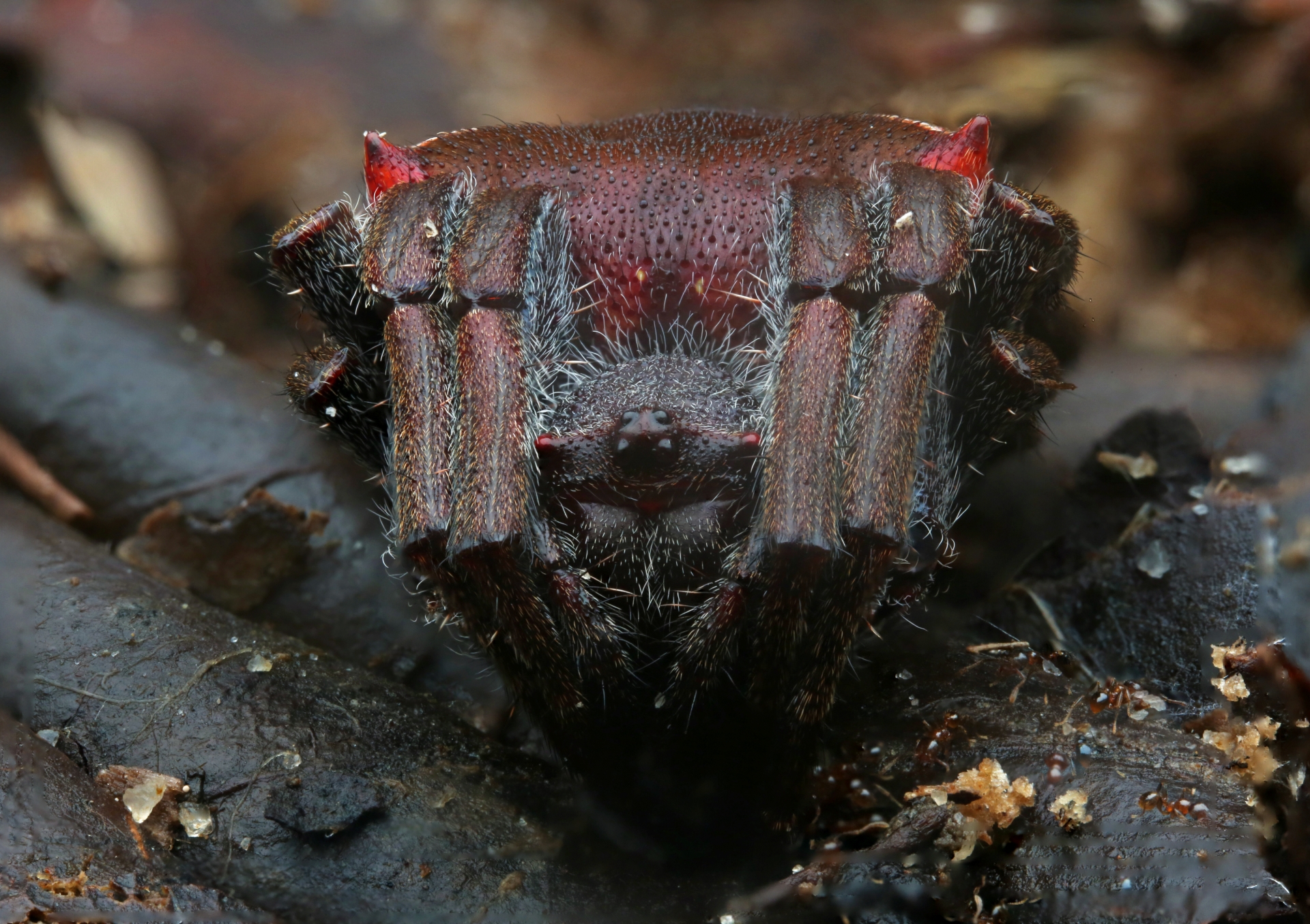
There is a distinct thrill that only a macro photographer truly understands. You are slowly panning a flashlight across a tangle of rainforest foliage, looking for anything that breaks the natural geometry of a leaf or a twig. Most of the time, your eyes play tricks on you. But every once in a while, a shape materializes out of the darkness that makes you freeze mid-breath.
That is exactly what happened when I crossed paths with this absolute marvel of natural engineering.
The Master of the Cryptic Tucking
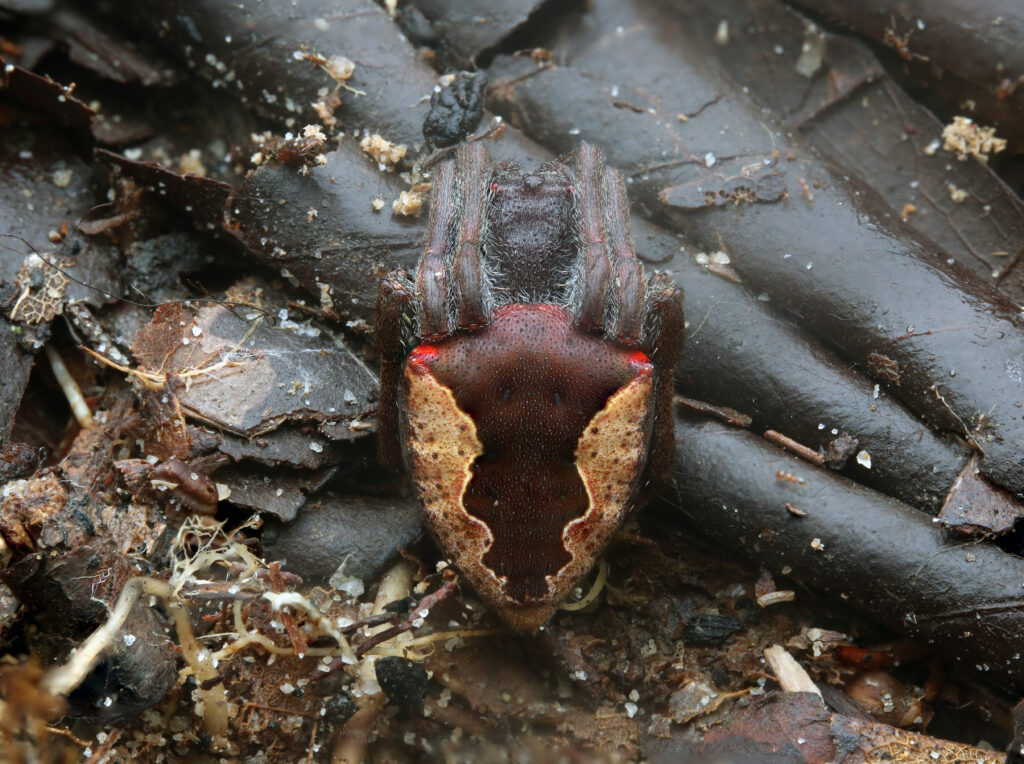
At first glance, it looks like a stray bit of dried plant matter, a broken seed pod, or a jagged piece of tree bark left behind by the elements. But look closer.
What you are looking at is one of the most phenomenal examples of cryptic camouflage in the arachnid world. Many tree-dwelling orb-weavers have evolved specialized body structures to survive the sharp eyes of daytime predators like birds and wasps. This particular genus is legendary for its ability to completely vanish in plain sight.
When the sun comes up, they don’t hide under leaves; they sit right out in the open. To achieve this, the spider draws its legs tightly inward, molding them flush against its sides. The front legs are structurally adapted with widened segments and curved ridges to perfectly cup the head, completely eliminating the telltale silhouette of an eight-legged predator.
Anatomy of a Miniature Monster
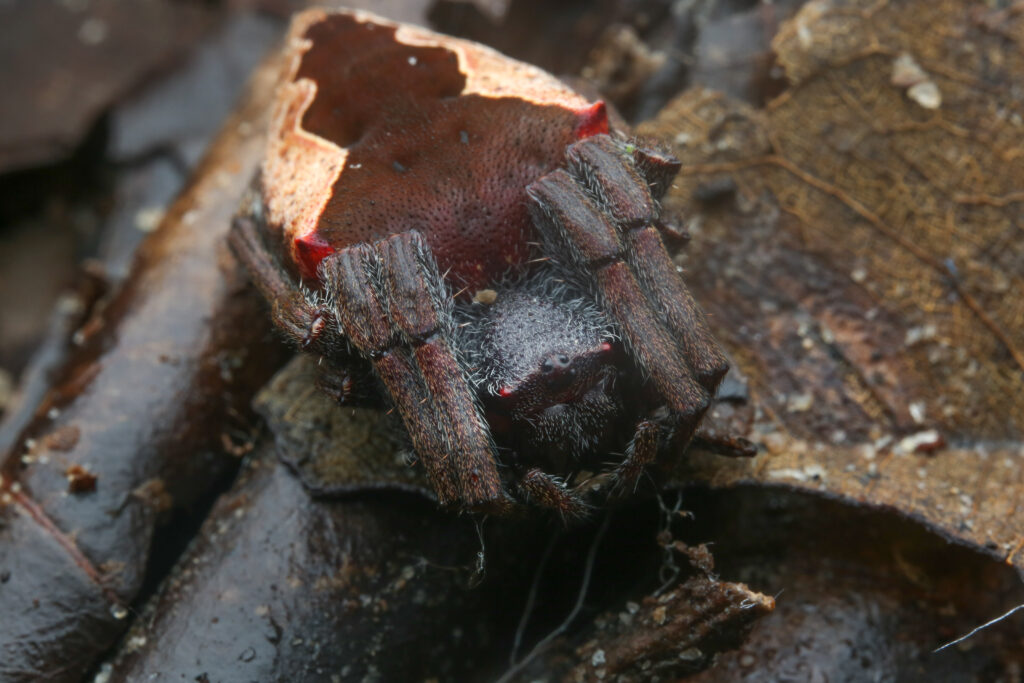
When you dial in the magnification, the true complexity of its armor reveals itself.
The top of the abdomen features striking, heavily textured protrusions—including those distinct, deep red horn-like structures cresting its form. Under a high-intensity macro flash, the coloration is beautiful: a deep, earth-toned gradient of rich browns and charcoal, broken up by that sudden, vivid splash of red on the horns.
The entire exoskeleton is covered in microscopic, fine sensory hairs and specialized pits called sigilla (the dark spots where internal muscles attach to the external shell). It doesn’t just look like bark; it mimics the exact tactile texture of the local Bornean flora.
Behind the Shot: Technical Breakdown
Documenting an organism this texturally complex requires a careful balance of gear and patience. When an insect or arachnid relies entirely on texture for its defense, standard flat lighting will completely ruin the shot.
- The Gear Setup: For macro field observations like this, a high-magnification setup is mandatory. I captured this utilizing a full-frame sensor paired with a dedicated manual macro lens dialed right into a high reproduction ratio to isolate the spider’s form from the background leaf.
- Controlling the Light: To make those rugged abdominal textures and red horns truly “pop,” I relied on a custom-diffused Godox flash setup. Direct flash creates harsh, specular highlights on a hard exoskeleton. By heavily diffusing the light and angling it slightly from the side, you cast tiny, microscopic shadows across the ridges of the abdomen, giving the final image an incredible sense of three-dimensional depth.
- The Field Challenge: When you are working at extreme macro distances, your depth of field shrinks to a razor-thin fraction of a millimeter. Even the slightest movement from a evening breeze will throw the entire subject out of focus. It requires bracing yourself against the forest terrain, holding your breath, and precisely rocking into the focal plane to ensure the eye clusters and those spectacular red horns remain tack-sharp.
Finding gems like this is a humbling reminder of the sheer, unmatched scale of biodiversity hiding right in our backyard. It’s a world where looking closer doesn’t just reveal more detail—it reveals an entirely different way to survive.
What’s the most bizarre example of insect camouflage you’ve ever spotted in the wild? Let me know in the comments below!