When trekking through the rainforest, it’s easy to focus entirely on the moving wildlife. But if you slow down and train your eyes on the rotting logs and mossy undergrowth, you’ll find that the fungal kingdom holds some of the most mesmerizing, quiet spectacles in nature.
On a recent field excursion, I stumbled upon a pristine, chalk-white bracket fungus nestled against a mossy log. What made it stop me in my tracks wasn’t just its texture—it was the collection of perfect, amber-tinted amber spheres suspended all around its edges.
This isn’t leftover rain or morning dew. You are looking at a biological process known as guttation.
The Science Behind the Spheres
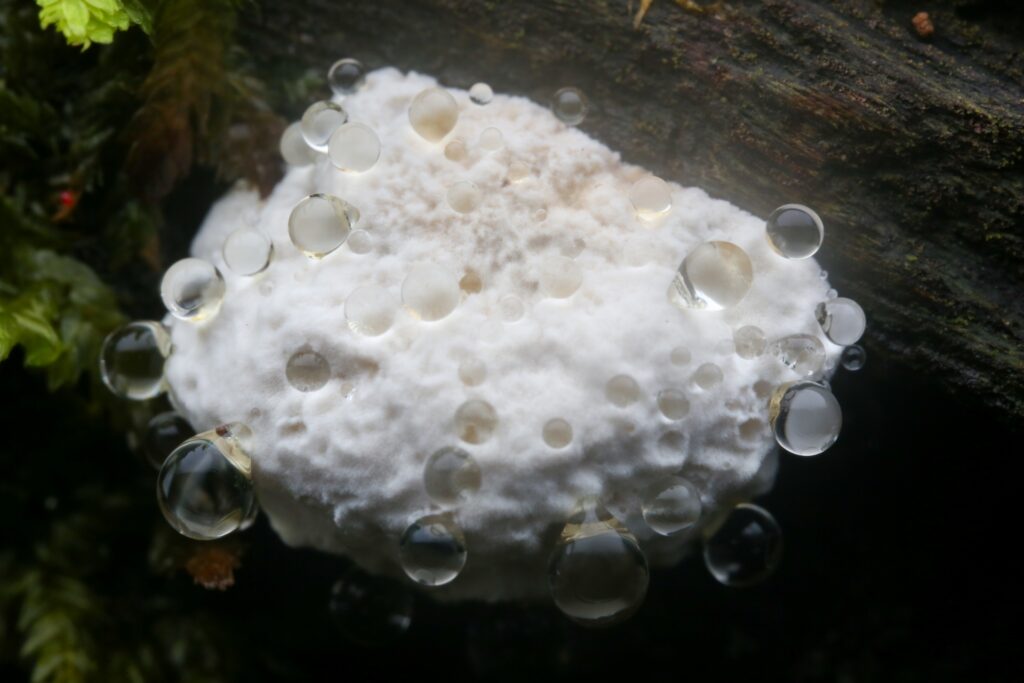
Fungi are incredibly active organisms. As they digest organic matter within a damp log, they absorb water rapidly through their underground network of mycelium. When the fungus experiences a period of rapid growth or high metabolic activity in a saturated environment, it can end up with an excess of moisture and internal pressure.
To release that pressure, the fungus forces moisture out through microscopic pores on its surface.
Because this liquid isn’t just pure water—it carries a cocktail of metabolic byproducts, enzymes, and mineral elements—the droplets often take on a thick, viscous quality and a subtle, warm coloration. They cling to the fungal body like perfectly formed glass marbles, refusing to drop until they grow too heavy for their own surface tension to hold.
Behind the Shot: Navigating the Reflection Challenge
Photographing guttation is a masterclass in managing reflections. Every single liquid droplet acts as a tiny, curved fisheye mirror, ready to bounce harsh light straight back into your camera sensor.
- The Lighting Strategy: If you hit these translucent droplets with hard, direct flash, you will end up with ugly, blown-out white hot spots (specular highlights) that completely ruin the delicate look of the fluid. For these shots, a soft, heavily diffused lighting setup was essential. By wrapping the light in a thick diffuser, the reflections on the spheres become soft, smooth gradients that accentuate their roundness rather than distracting from it.
- Managing Exposure and Contrast: The contrast between the stark white, velvety surface of the fungus and the deep, dark shadows of the damp, mossy wood requires careful exposure management. You have to expose carefully to keep the fine, dimpled details on the white fungal body from clipping into pure white, while keeping enough detail in the background moss to frame the subject naturally.
- Reproduction Ratio & Focus: Moving from an environmental portrait of the fungus (
SJE_1305.jpg) to a tighter macro crop (SJE_1308.jpg) completely changes the mood. At higher magnification, your depth of field shrinks to a razor’s edge. The goal here was to keep the outer ring of weeping droplets tack-sharp, allowing the viewer to peer straight through the liquid as it refracts the tiny details of the moss and bark underneath.
Finding a perfect example of guttation in pristine condition is a reminder of how dynamic and alive the forest floor really is. It’s a temporary masterpiece that might vanish by midday, making it all the more rewarding to capture.
Have you ever encountered weeping fungi on your nature walks, or captured refraction in macro droplets? Let’s talk setups and techniques in the comments below!