When most people think of katydids, they imagine a bright, leaf-mimicking green insect hiding flawlessly in the canopy. But the undergrowth of the lowland rainforest holds variations that challenge that standard definition entirely.
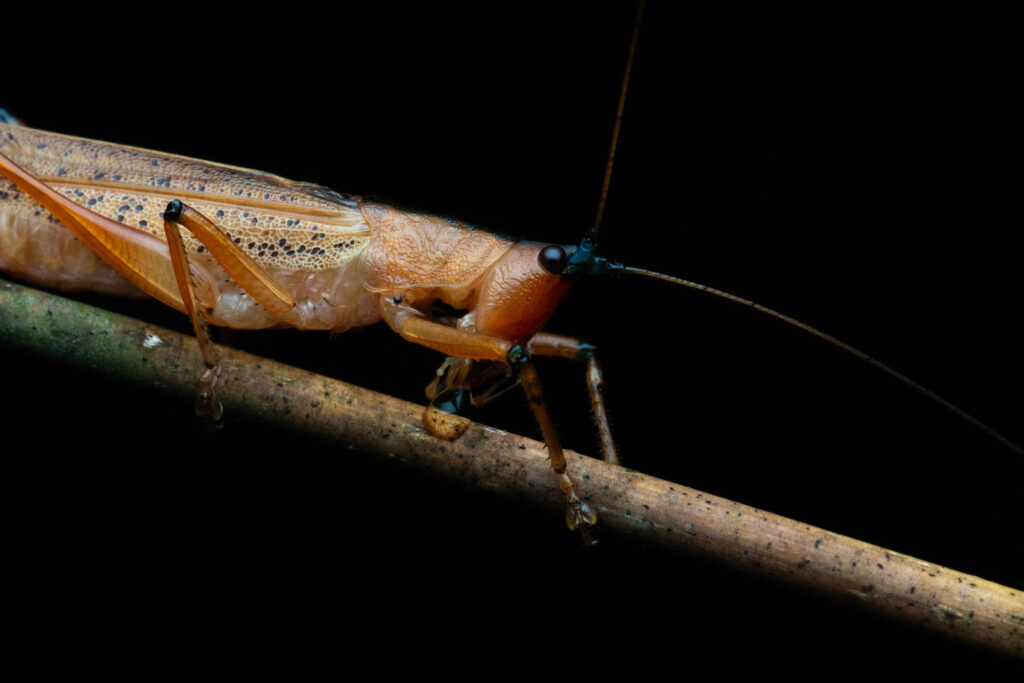
On the return leg of our trek, walking past the low branches along the trail, this striking conehead katydid (Orthoptera: Tettigoniidae) stood out perfectly against the deep velvet black of the night forest.
Perched calmly on a bare, horizontal twig, it wasn’t relying on leaf-green camouflage. Instead, it showed off a rich palette of warm, organic textures mixed with a completely unexpected pop of brilliant color.
A Stark Study in Contrasts
Under a well-diffused flash, this katydid proves that orthopterans can be just as intricate as any master-of-disguise stick bug.
- The Speckled Profile: The forewings (tegmina) feature a gorgeous, granular pattern of dark brown speckles scattered over a tawny, orange-brown canvas. The venation looks less like a fresh leaf and more like dried foliage or dead leaf tissue.
- The Cyan Mask: The absolute highlight of this specimen is the localized splash of color around its face. Right at the crown of its head and encircling the base of its antennae (the scape), the exoskeleton transitions into a sharp, vibrant blue-green hue. This rich cyan accent creates a striking focal point next to its dark compound eye.
- Built for Action: The close-up frames lock onto its powerful mouthparts and the spine-lined forelegs. Many conehead varieties in the tropics lean toward a predatory diet, using these robust legs to snatch smaller insects out of the air or off the leaves before using powerful mandibles to finish the job.
The Macro Perspective
What makes these encounters so rewarding is how a macro lens completely isolates a subject. Against a clean, dark backdrop, the form of the insect takes center stage—from the fine hairs on its tarsi grasping the bark to the sheer length of its antennae sweeping out of the frame.
It’s a reminder that even when you aren’t stumbling across the absolute rarest micro-fauna on Earth, the common inhabitants of massive habitats like Kampung Stass carry details that deserve a spotlight.
Another sharp set of frames down, another species logged, and the digital field guide fills out just a little bit more.
Field Notes:
- Location: Lowland forest undergrowth
- Subject: Conehead Katydid (Tettigoniidae)
- Visual Highlight: The incredible blue antennal bases