When shifting focus from phasmids and mantises to the world of arachnids, you find a completely different style of habitat modification. Insects excel at looking like leaves and twigs; spiders excel at bending those leaves and twigs to their absolute will.
On tonight’s night walk through the local perumahan bushes, this brilliant crab spider (Araneae: Thomisidae) showed off a stunning mix of protective engineering and maternal instinct. Instead of sitting out in the open on a flower petal to ambush flies, this pale green hunter had constructed a permanent, high-density silken fortress right inside a folded blade of vegetation.
Engineering the Folded Leaf Retreat
While many crab spiders are free-roaming ambush predators, females frequently build highly specialized, hidden chambers when it is time to lay or guard their egg sacs.
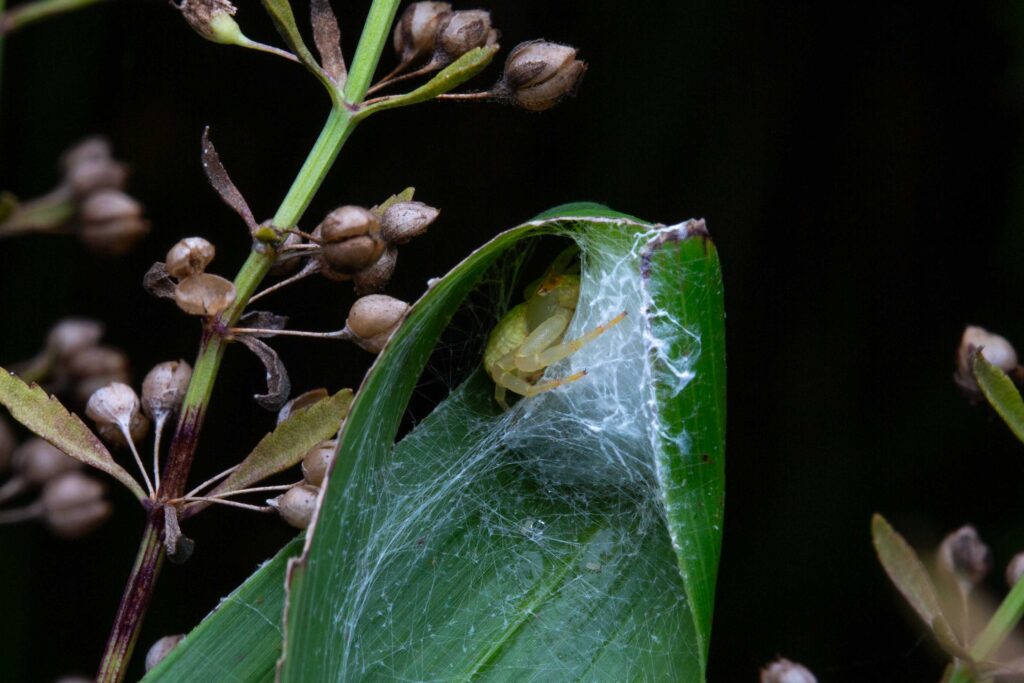
- The Silken Sheet: The macro frame captures a beautiful look at the dense structural webbing. The spider has pulled the upper lip of a green leaf down, securing it with thick, structural lines of white silk to form a tiny cave. The density of the web acts as both a weather shield and an early warning alarm system against wandering ants.
- The Pale Green Sentinel: Peering out from the mouth of the retreat, the translucent lime-yellow and green limbs of the spider blend seamlessly into the shadows of the inner leaf. Its front legs are kept tightly tucked but primed to strike, keeping watch over the entrance.
- Roadside Botany: The composition pairs the clean green lines of the nest with a neighboring wild stalk full of dried brown seed pods. It’s a reminder of just how much structural texture is hidden in ordinary roadside weeds when you approach with proper diffusion and an isolated background.
The Mastery of the Macro Nursery
Hunting for macro subjects in disturbed suburban zones requires you to look for irregularities in the foliage. A leaf that is abnormally bent, curled, or tied together with white thread is almost always a sign of an arachnid home.
Slowing down to inspect these micro-habitats continues to expand the Minutia Flux collection into the fascinating world of urban arachnids.
Field Notes:
- Location: Suburban backyard bushes / Perumahan
- Subject: Crab Spider (Thomisidae) in Nest
- Technique: Finding visual anomalies in folded roadside foliage